When Your an Adult and Your Baby Tooth Gum Swells
Past: Dina DiMaggio, Md, FAAP & Julie Cernigliaro, DMD
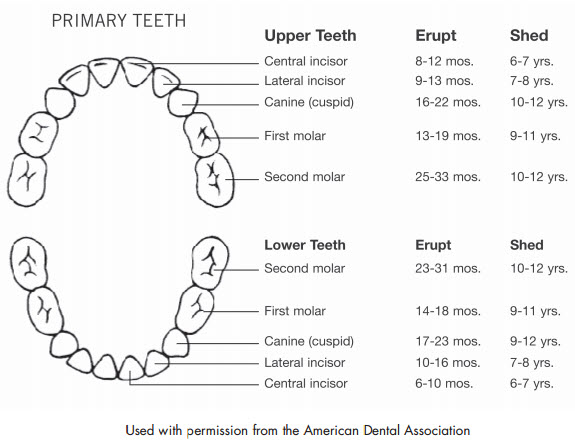
1. Most babies volition develop teeth betwixt 6 and 12 months.
There is a wide range of variability of when a first tooth may appear—some babies may not take whatever teeth by their start birthday! Around 3 months of age, babies will begin exploring the globe with their mouth and have increased saliva and first to put their hands in their oral fissure. Many parents question whether or not this means that their baby is teething, but a offset tooth usually appears around half dozen months old. Typically, the offset teeth to come in are almost always the lower front teeth (the lower central incisors), and well-nigh children volition normally take all of their infant teeth by age 3.
2. Fluoride should exist added to your child's diet at 6 months of age.
Fluoride is a mineral that helps prevent tooth decay by hardening the enamel of teeth. The good news is that fluoride is often added to tap water. Requite your baby a few ounces of water in a sippy or straw loving cup when you begin him or her on solid foods (about 6 months of historic period). Speak with your pediatrician to run into if your tap h2o contains fluoride or whether your kid needs fluoride supplements. Fluoride is non typically found in almost bottled water. Encounter FAQ: Fluoride and Children for more information.
3. Massaging sore gums, offering something cold, or acetaminophen, on an occasional crude night, can help soothe your baby'due south teething pain.
Unremarkably teething doesn't cause children likewise much discomfort, withal, many parents tin can tell when their baby is teething. Babies may evidence signs of discomfort in the surface area where the tooth is coming in, the gums around the tooth may be swollen and tender, and the infant may drool a lot more than usual.
Parents can assistance ease teething pain by massaging their baby's gums with clean fingers, offering solid, non liquid-filled, teething rings, or a clean frozen or wet washcloth. If y'all offer a teething biscuit, brand sure to watch your baby while he or she is eating it. Chunks tin break off hands and can atomic number 82 to choking. Also, these biscuits are not very nutritious and most contain sugar and table salt.
A babe'south body temperature may slightly rise when teething; however, according to a 2016 study in Pediatrics, a true fever (temperature over 100.4 degrees Fahrenheit or 38 degrees Celsius) is not associated with teething and is really a sign of an illness or infection that may require treatment. If your baby is clearly uncomfortable, talk with your pediatrician about giving a weight-advisable dose of acetaminophen (eastward.thou., Tylenol) or if over 6 months, ibuprofen (e.g., Advil, Motrin). Make sure to ask your pediatrician for the correct dose in milliliters (mL) based on your child's age and weight.
Many children, however, volition take no problems at all when their teeth come up in!
iv. Do non use teething tablets, gels with benzocaine, homeopathic teething gels or tablets, or bister teething necklaces.
Stay away from teething tablets that contain the establish toxicant belladonna and gels with benzocaine. Belladonna and benzocaine are marketed to numb your child's pain, but the FDA has issued warnings against both due to potential side effects.
In addition, amber teething necklaces are not recommended. Necklaces placed effectually an infant's neck can pose a strangulation risk or exist a potential choking run a risk. There is besides no enquiry to back up the necklace'southward effectiveness. Come across Teething Necklaces and Beads: A Caution for Parents for more information.
five. Y'all should brush your kid'southward teeth twice a 24-hour interval with fluoride toothpaste.
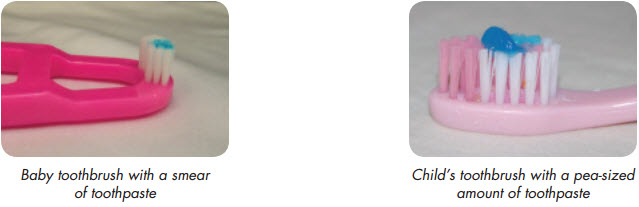 Once your child has a tooth, you should exist brushing them twice a 24-hour interval with a smear of fluoride toothpaste the size of a grain of rice, especially after the last drink or food of the day. Call up not to put your baby to bed with a bottle—it can lead to molar decay.
Once your kid turns iii, the American Academy of Pediatrics (AAP), the American Dental Association (ADA), and the American Academy of Pediatric Dentistry (AAPD)recommend that a pea-sized amount of fluoride toothpaste exist used when brushing. When your child is able, teach him or her to spit out the backlog toothpaste. It is all-time if you put the toothpaste on the toothbrush until your child is near age 6. Parents should monitor and aid their child while brushing until he or she is effectually 7 or 8 years quondam. When your child can write his or her name well, he or she besides has the ability to castor well.
6. Ask your pediatrician about your baby's teeth and fluoride varnish.
During regular well-kid visits, your pediatrician volition bank check your infant's teeth and gums to ensure they are healthy and talk to you nigh how to proceed them that way. The AAP and the Usa Preventive Services Task Force also recommend that children receive fluoride varnish once they take teeth. If your child does not notwithstanding have a dentist, enquire your pediatrician if he or she can apply fluoride varnish to your baby's teeth. Once your child has a dentist, the varnish can be applied in the dental office. The earlier your child receives fluoride varnish the improve to help preclude tooth decay.
seven. Make your get-go dental appointment when the first tooth appears.
Effort to make your baby'due south first dental appointment after the eruption of the commencement tooth and by his or her first birthday.
Both the AAP and the AAPD recommend that all children see a pediatric dentist and establish a "dental habitation" by age 1. A pediatric dentist volition make certain all teeth are developing normally and that there are no dental problems. He or she will also give you further communication on proper hygiene. If you don't have a pediatric dentist in your community, find a general dentist who is comfortable seeing young children.
Boosted Information:
-
Brushing Up On Oral Health: Never Too Early to Start
-
How to Prevent Tooth Decay in Your Baby
-
Brush, Book, Bed: How to Structure Your Child'due south Nighttime Routine
-
Give Your Baby the Best Possible Start
About Dr. DiMaggio:
 Dina DiMaggio, MD, FAAP, is a board certified pediatrician at Pediatric Associates of NYC and at NYU Langone Medical Center. She is the co-writer of The Pediatrician'south Guide to Feeding Babies and Toddlers, a comprehensive transmission written by a team of medical, nutrition, and culinary experts. Follow her on Instagram @Pediatriciansguide.
Nigh Dr. Cernigliaro:
 Julie Cernigliaro, DMD, is a lath certified pediatric dentist and the Acquaintance Director of the Pediatric Dental Residency Programme at Lutheran Medical Center in Brooklyn, NY. She holds a kinesthesia position at NYU College of Dentistry and currently works in private practice at Happy Smile Pediatric Dentistry, PC in NYC.
The data contained on this Web site should not be used as a substitute for the medical care and communication of your pediatrician. At that place may be variations in handling that your pediatrician may recommend based on private facts and circumstances.
Source: https://healthychildren.org/English/ages-stages/baby/teething-tooth-care/Pages/Babys-First-Tooth-Facts-Parents-Should-Know.aspx
0 Response to "When Your an Adult and Your Baby Tooth Gum Swells"
Post a Comment