How to Remove and Add Again the Background of an Image Matlab
Introduction to Matlab Images
Paradigm Processing apps are provided by MATLAB in the form of a toolbox that helps u.s. in automating usually used paradigm processing techniques and workflows by enabling interactive division of paradigm data, comparison of image registration methods, and batch processing of big datasets. Prototype processing in MATLAB lets us explore any prototype or video and make changes similar adjusting the contrast, manipulating ROI (regions of interest) and create histograms to empathise the definition of the image.
Here is the listing of some of the most commonly used functions for processing image in MATLAB:
- imread(): This function is used to read or load the image which we want to process
- imshow(): This function is used to display the image that we have loaded
- imagesc(): This function is used to display the prototype by utilizing the total set of colors present in the colormap. A color scale can likewise be used afterwards calling this function to go a better idea of the colors present
- imhist(): Using This part nosotros can cheque how the pixel intensity of the prototype is distributed
- histeq(): Using this role we can edit the contrast of our paradigm
- imwrite(): This function is used to insert our edited paradigm into a file
- iminfo(): This function is used to confirm if our edited file is loaded into a disk file
Functions for Matlab Images
Let us now understand the use of all the above functions in MATLAB. We will utilise an prototype that is stored in MATLAB'southward epitome processing app and volition execute all the above functions in steps for that prototype.
Stride 1
In the first footstep, nosotros Load or Read the image into our workspace.
Code:
imageInput = imread ('moon.tif');
['imread' will read the epitome and volition store it in the array 'imageInput']
Stride two
In this step we volition display our image in the workspace.
Code:
imshow (imageInput)
['imshow' will brandish the image as output in the workspace]
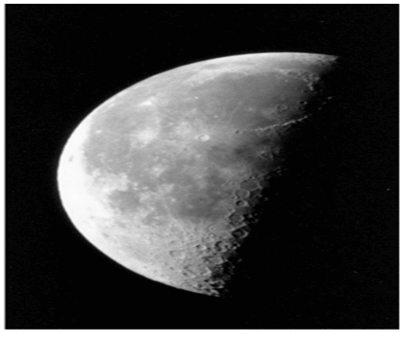
As we can see in the output, the image is loaded in our workspace.
Step three
In this pace we will brandish our image with the colors from the colormap. We will also use a color bar to cheque the intensity of the colors.
Code:
imagesc (imageInput)
['imagesc' will display the image with a total range of colors from the colormap]
colorbar
['colorbar' is used to display a calibration side by side to the image to check the intensity of the colors]
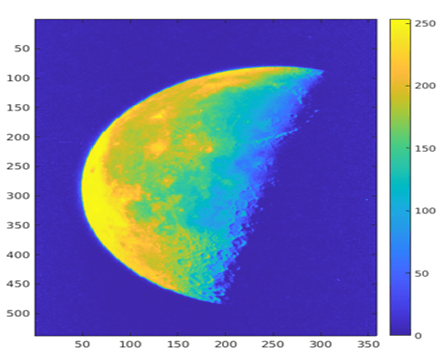
As we can see in the output, the image is displayed and has a total range of colors in the colormap and we besides accept a color bar next to information technology.
Stride four
In this step nosotros volition bank check the intensity of pixels in our image. We will be using the figure function to brandish the intensity in the form of a histogram.
Code:
figure
[Used to display the histogram for intensity]
imhist (imageInput)
['imhist' will create distribution of the pixel intensities]
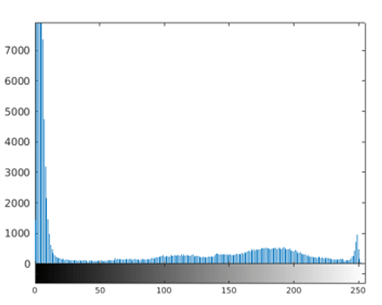
Equally we can see in the output, the range of pixel intensity for our image is very narrow, i.due east the values are concentrated in a small range at the starting time.
Step v
In this pace, we will edit the contrast of our epitome. This is done because we constitute in the higher up stride, that our image has very narrow pixel intensity.
Code:
newImage = histeq (imageInput);
['histeq role will meliorate the pixel intensity or we tin can say that it will meliorate the contrast of our image]
figure
                imshow (newImage)
[Displaying our new prototype (with improved contrast]
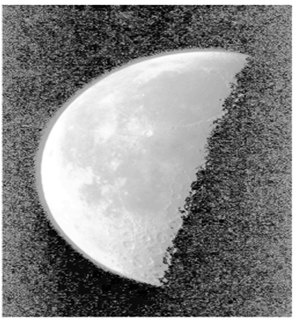
Every bit we tin see in the output, the contrast of our prototype has inverse drastically.
Step 6
In this pace, let us call 'imhist' function again with 'newImage' as the input. This will confirm that dissimilarity or pixel intensities of the new image created are now distributed in a better style
Code:
figure
                imhist (newImage)
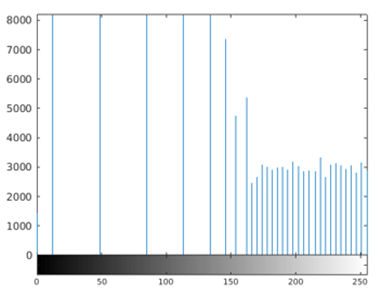
As we can see in the histogram above, the pixel intensities of the new image created are at present distributed in a better manner.
Step 7
In this footstep, we volition insert the new epitome into deejay file.
Code:
imwrite (newImage, 'moon2.png');
[Using 'imwrite' to salvage the epitome in disk file]
Footstep eight
Finally, we will confirm if our image is saved in the disk file or not using the 'iminfo' role. This will also give united states of america all other details like file size, format, width, elevation, etc.
Code:
imfinfo ('moon2.png')
[Getting the information of the saved file]
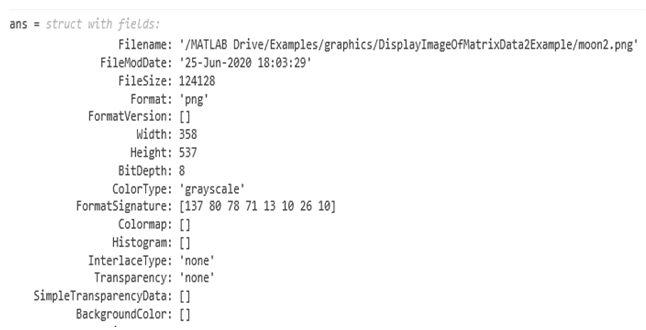
As we tin see in the output, the file is saved as expected by us. Nosotros also accept all other information related to the image.
Decision
Image processing app can be used in MATLAB to perform various operations on an image, ranging from loading the prototype editing it and saving it in the disk file. The epitome processing can be used to process both 2nd& 3D images.
Recommended Articles
This is a guide to Matlab Images. Here nosotros also talk over the introduction and use of functions in matlab along with examples and its lawmaking implementation. You may also have a look at the post-obit articles to larn more than –
- Matlab Plot Colors
- Heaviside MATLAB
- Factorial in Matlab
- Fourier Series Matlab
Source: https://www.educba.com/matlab-images/
0 Response to "How to Remove and Add Again the Background of an Image Matlab"
Post a Comment